
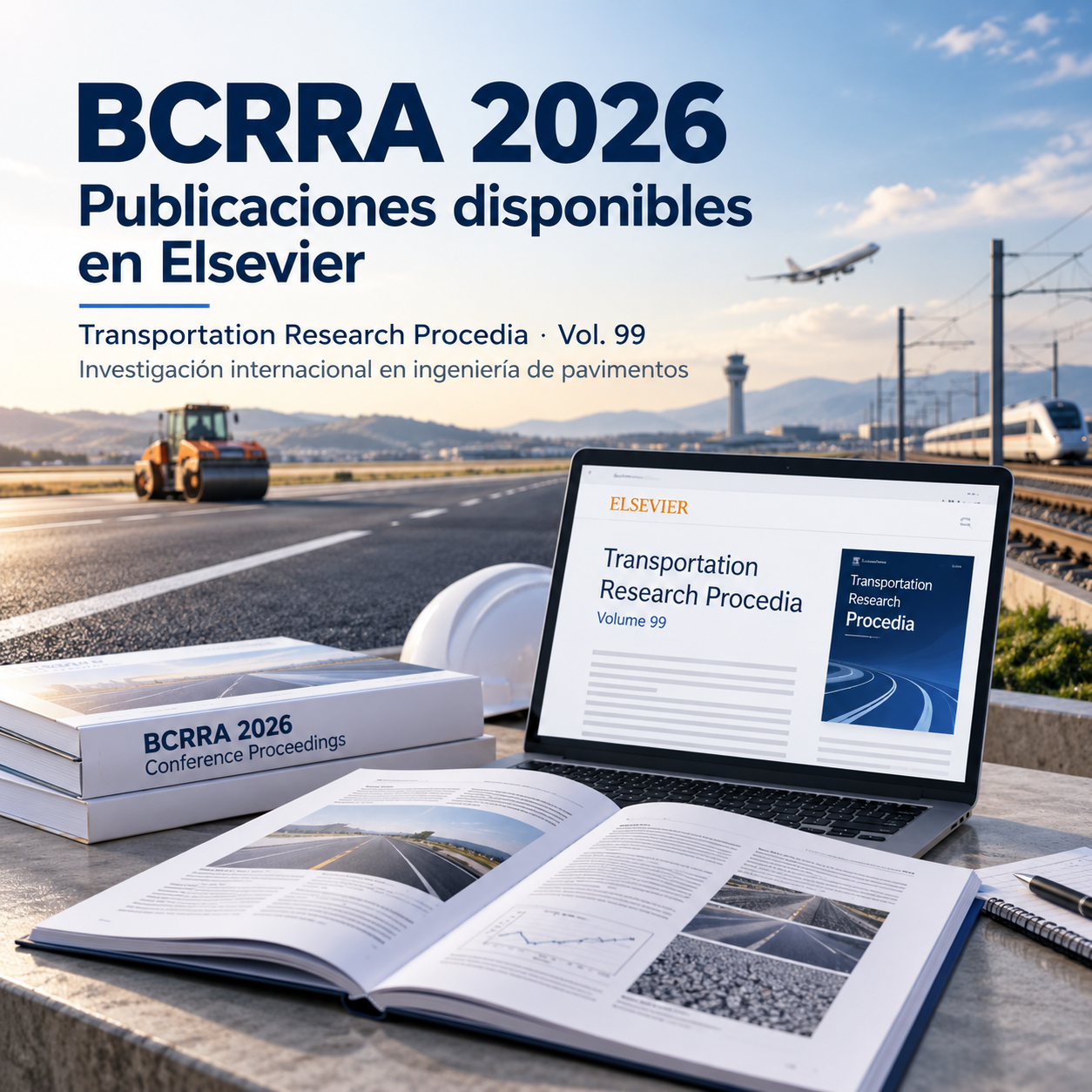
RAUROS Strengthens Its International Scientific Presence with BCRRA 2026 Publications in Elsevier
The scientific papers presented at the 12th International Conference on Bearing Capacity of Roads, Railways and Airfields (BCRRA 2026), held in Ljubljana, Slovenia, from June 22 to 24, are now available in Volume 99 of Elsevier’s Transportation Research Procedia through ScienceDirect. RAUROS is among the contributors, with specialized research on perpetual pavement design.
BCRRA 2026 Elsevier: The scientific papers presented at the 12th International Conference on Bearing Capacity of Roads, Railways and Airfields, held in Ljubljana, Slovenia, from June 22 to 24, are now available in Volume 99 of Transportation Research Procedia through ScienceDirect. Among them is a research paper by RAUROS focusing on perpetual pavement design.
BCRRA is an international forum for scientific and technical exchange in the field of transport infrastructure engineering. Its programme addresses topics related to the structural behaviour of pavements, bearing capacity assessment, new materials, sustainability, maintenance, and the application of advanced technologies to roads, railways and airfields.
Publication of the Conference’s Scientific Papers
The BCRRA 2026 publications in Elsevier bring together international research that contributes to advancing methodologies for transport infrastructure design and assessment.
The papers have been published in Volume 99 of Transportation Research Procedia, published by Elsevier, a scientific publication indexed in Scopus.
This collection provides access to research and methodological advances related to the design, assessment and performance of transport infrastructure.
The papers cover various areas of pavement engineering, including structural analysis, design methodologies, material behaviour, pavement condition assessment techniques, and improvements in infrastructure durability and sustainability.
RAUROS’ Scientific Contribution
At this edition, RAUROS contributed the paper “Updating perpetual pavement design criteria: from legacy practices to strain ratio-based methodologies”, authored by F. Damián Suárez Mendo, J. Antonio Ramos García and Fernando Varela Soto.
The research examines the evolution of perpetual pavement design criteria, analysing the limitations of certain traditional methodologies and the introduction of mechanistic-empirical approaches based on strain ratios.
The study explores how structural assessment criteria can be updated by considering both fatigue mechanisms in asphalt layers and permanent deformation of the subgrade, with the aim of contributing to the development of more durable and technically sound pavement solutions.
Applied Research for Infrastructure Development
The dissemination of the BCRRA 2026 papers highlights the importance of scientific research and knowledge transfer in addressing today’s challenges in pavement engineering.
For RAUROS, participating in international conferences and scientific publications provides an opportunity to share technical expertise, compare methodologies and contribute to the advancement of innovative solutions for infrastructure design, assessment and maintenance.
This activity reflects the company’s commitment to innovation, technical excellence and the development of engineering solutions grounded in scientific knowledge.
These scientific advances also contribute to improving pavement management and pavement management systems (PMS), areas in which RAUROS develops data-driven solutions to optimize road infrastructure maintenance and planning.
Structural Design and Durability of Perpetual Pavements
The concept of perpetual pavements refers to structures designed to maintain long-lasting performance under traffic loading, with particular attention to deterioration mechanisms that may compromise their long-term structural response.
Structural assessment criteria should therefore account for both fatigue mechanisms in asphalt layers and the accumulation of permanent deformation in the subgrade.
The research presented by RAUROS at BCRRA 2026 examines the transition from traditional design criteria towards methodologies based on strain ratios. This approach provides deeper insight into the structural behaviour of materials and establishes technical foundations for assessing different design alternatives.
These advances are also relevant to road asset management. Having appropriate design criteria and reliable data on pavement performance helps improve maintenance planning, assess future needs and guide investment prioritization.
These research advances establish a direct link between pavement structural design and efficient infrastructure life-cycle management.